New US strategy: derailing Europe
11. 12. 2025 / Matěj Metelec
čas čtení
4 minuty

"Among the problems facing Europe," the document states, "are the actions of the European Union and other supranational bodies that undermine political freedom and sovereignty, migration policies that are changing the continent and creating conflicts, censorship of free speech and suppression of political opposition, declining birth rates, and the loss of national identity and self-confidence."
In reality, this is not a strategy, but a Vance-style ideological assessment based on conservative and nationalist criticism (especially of EU institutions). The same spirit pervades the entire text. The passage devoted to Europe is remarkable mainly for the various facets of reactionism it is imbued with. Sometimes very old, as when he speaks in the spirit of "the decline of the West" about how European "economic decline overshadows the real and much harsher prospect of civilizational obliteration," and sometimes relatively old, such as the claim that in twenty years Europe will be unrecognizable, which is strikingly reminiscent of the far-right conspiracy theory of the Great Replacement.
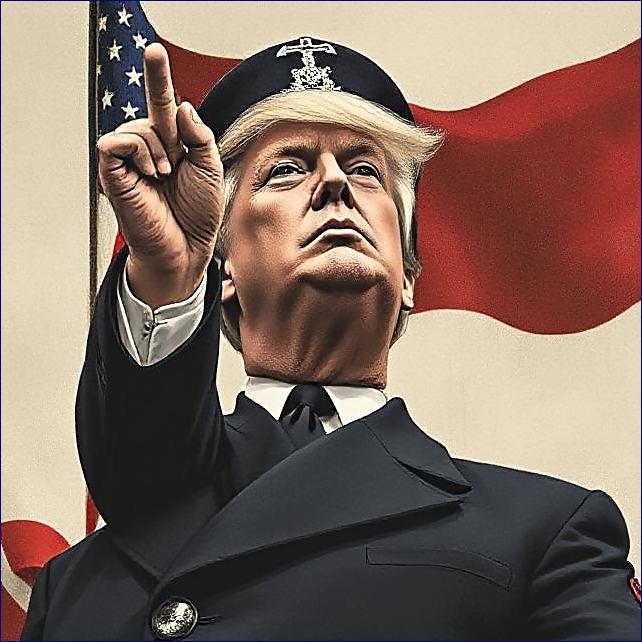
Such ideological outbursts are just another sign that the Trump administration is working intensively on a project of 21st-century fascism, but what is also remarkable is this regime's willingness to deceive itself in such proclamations. While it is true that "continental Europe is losing its share of global GDP—from 25 percent in 1990 to 14 percent today," to cite as the causes of this situation exclusively "national and supranational regulations that undermine creativity and hard work" cannot be considered a creative interpretation of reality intended for European leaders, but rather American self-deception. Comparably, the American share of global GDP has also declined over the last decade, and the cause of the weakening importance of the old industrial countries is not that they "did not try hard enough," but rather the rise of the rest of the world. Regardless of what Trump and his MAGA followers believe, America will never again be as great as it was when the economies of the global South were still predominantly agricultural.
Given that it was the United States that led the collective West for the last 80 years, including more than three decades after the fall of the Soviet Union, it seems absurd to read in the new concept that "many Europeans see Russia as an existential threat." After their victory in the Cold War, the Americans could have done many things to prevent such a threat from emerging, as they did after World War II in the case of Germany and Japan. The misconception that a unipolar world would last forever led to excessive triumphalism, which overstretched American forces without producing the desired results. The reproaches made by Trump and his administration's representatives towards Europeans for their unwillingness to take care of their own security only make sense to the extent that we read them as a rejection of responsibility for the fact that it was the United States, by vacillating between global leadership and global domination, that led European states into a situation where they need to invest more in their defense—precisely because of Russia, which, according to the new NSS, does not pose an existential threat!
And as if that were not enough, self-deception and inconsistency are complemented by implicitly disruptive statements towards the EU, which, for a change, resemble the rhetorical exhibitions of Trump's former close ally Elon Musk, who has long had a bone to pick with European institutions because they restrict his business. It is a big question what might be hidden behind phrases such as: "America encourages its political allies in Europe to support this revival of spirit, and the growing influence of patriotic European parties does indeed give cause for great optimism." The call for these allies to "cultivate resistance to the current direction of Europe among European nations" will in any case be very difficult to interpret as a gesture of friendship in any sense of the word by current European leaders and institutions. However, the current strategy of trying to flatter Trump into benevolence with regard to Washington's strategic vision is clearly not working very well.
Trump's new National Security Strategy is right about one thing : the European Union member states must choose between trying to maintain their traditional post-war position as the "junior" partner of the United States, which, given American plans, could mean the renewed disintegration of Europe into parts subordinate to nuclear hegemonies, or finding the will to gradually build an autonomous security and political position. If they decide to try the second option, their biggest opponent will not be Donald Trump or even Vladimir Putin, but the ambitions of the European allies of both presidents.
4186
Diskuse